Wednesday, November 25, 2020

FRED SASAKAMOOSE

HIS TIME WITH THE BLACK HAWKS  

Fred Sasakamoose, one of the first Indigenous players in the National Hockey League, passed away on Tuesday afternoon at the age of 86. The news of his death came in an emotional Facebook video from his son, Neil. Tears filled his eyes as he spoke lovingly about his father. The cause of death was revealed as COVID-19. 

He was raised in Ahtahkakoop Cree Nation in Saskatchewan (Big River First Nation). His dream as a boy was to play hockey, and as paNOW.com reported, "His first pair of skates were his moccasins with a bob skate blade strapped on underneath, and five pairs of socks to keep his feet from freezing."

Sasakamoose played his junior hockey in the Western Canada Hockey League with the Moose Jaw Canucks. In his first three seasons, Sasakamoose scored 44 goals for Moose Jaw.

Prior to entering his fourth year with the Canucks, Sasakamoose attended the Chicago Black Hawks fall training camp in Pembroke, Ontario. The camp opened on September 8, 1953, and was designed for Chicago coach, Sid Abel, to size up the prospects in the Hawks' system.

In a clash of the East Juniors vs. West Juniors on September 12, Sasakamoose and his teammates defeated the East 5-3. He scored one goal and was selected "as the first all-star in the game."

Despite his impressive performance, Sasakamoose was unable to earn a roster spot with Chicago. He returned to Moose Jaw and began his final year of junior with the Canucks.

When the Hawks stumbled out of the starting gate with only three wins in their first 20 games, they summoned Sasakamoose from Moose Jaw. On November 19, Sid Abel announced that his rookie would play between wingers George Gee and Bill Mosienko.

At the age of 19, Sasakamoose made his NHL debut on November 20, 1953, when the Hawks hosted the Boston Bruins. Although Chicago was shutout by a score of 2-0, Sasakamoose made an impression. "Fred Sasakamoose, whose Cree Indian name in Chief Running Deer, made his debut in [sic] Black Hawk uniform and gave a spirited account of himself," reported the Chicago Tribune. "The chief displayed a pleasing willingness to rough it up, and got off two or three good shots.

At first, it was expected Sasakamoose would remain in Chicago for the customary three game try-out, but after a 5-1 loss to the Toronto Maple Leafs at Chicago Stadium, the Hawks decided to return him back to the Canucks.

Back in junior hockey, Sasakamoose reflected on his experience in Chicago. "They play it rugged up there - especially those big defensemen - the goalies play the angles. Ted Kennedy is one of the best players I faced - Chicago sure is a big, windy city."

As Chicago continued to struggle, Sasakamoose got a second chance with the Hawks as they recalled him on February 25, 1954. Along with the promotion, the Hawks revealed that Sasakamoose would finish the season in Chicago.

Sasakamoose returned to the NHL on February 27, 1954, when the Hawks battled the Toronto Maple Leafs at Maple Leaf Gardens. This was a special contest for Sasakamoose, as each Saturday night, he would listen to Foster Hewitt call games from the gondola at the Gardens.

Following the game against Toronto, nine games remained in Chicago's regular season. And like his first stint with the Hawks, the club didn't enjoy much success on the ice. They only managed two victories and  when the final curtain fell, they set a new record for most losses in a season with a miserable 12-51-7 record. 

His last game in the National Hockey League was played on March 19 at home against the Boston Bruins.  Sasakamoose didn't dress for the Hawks season finale on the road in Boston two night's later.

In Sasakamoose's swan song on the 19th, the Hawks defeated the Bruins 7-0 at the Stadium. The scoring hero for Chicago was Pete Conacher. The Toronto native recorded his first and only three goal game in the NHL.

"I only scored one hat trick in the NHL and that was in the second last game of the season," Conacher told me this afternoon when I called him to talk about his former teammate, Fred Sasakamoose.

"It had to be great for him to be there," said Conacher of Sasakamoose's journey. "As bad as we were, to be in the National Hockey League, and playing in a rink like Chicago Stadium, it had to be a real thrill to take back home."

 In the short time he got to witness him play in the NHL, one skill Sasakamoose possessed stood out to Conacher. "He was a good skater," Conacher said of his ability to maneuver around the ice. 

Off the ice, Conacher observed that Sasakamoose "was a quiet guy and in awe of being in a big city like Chicago."

"I was shocked to read this morning what happened to him," Conacher said in a hushed tone.

On Twitter, the Chicago Blackhawks posted a statement: Today, we lost a luminary in the hockey world with the passing of Fred Sasakamoose. Fred inspired many across the sport and throughout North America after becoming one of the first Indigenous-born athletes to play in the National Hockey League when he played 11 games with the Blackhawks during the 1953-54 season. Fred's family spoke of his love for his culture, his people and his language. That lasting impact of his legacy will forever be celebrated and continue to bring people together for generations to come. To the entire Sasakamoose family that includes his wife, Loretta, four children and over 100 grandchildren and great-grandchildren, the Chicago Blackhawks organization extends our deepest condolences.

In 11 games with Chicago, Sasakamoose didn't register point and spent six-minutes in the penalty box. 

Monday, November 23, 2020

AN ORIGINAL PENGUIN

 KEN SCHINKEL: 1932-2020


Ken Schinkel, who passed away last week, began his National Hockey League career in 1959-60 with the New York Rangers. The previous season, he led all goal-scorers in the American Hockey League with the Springfield Indians. In 70 games with the Indians, he potted 43 goals and 42 assists for 85 points.

When the Boston Bruins held their home opener on October 10, 1959, Schinkel scored his first two goals in the big-show. Unfortunately for Schinkel and the Rangers, they lost to the Bruins by a score of 6-4.

Schinkel had a decent first year with New York as he scored 13 goals in 69 contests and accumulated 29 points. He finished a distant third in voting for the Calder Trophy, which is awarded to the NHL's top rookie. Chicago's Bill Hay was the winner and Detroit's Murray Oliver finished in second-place.

Prior to NHL expansion in 1967, Schinkel found himself bouncing between the NHL with New York and the AHL with Springfield and Baltimore. His best season in the AHL came in 1965-66 with the Baltimore Clippers when he registered 75 points - 30 goals & 45 assists - in 72 games.

With the Rangers, Schinkel was unable to repeat the success he experienced in his first season. But like many in the Original Six era, Schinkel got a second chance with the expansion from six to twelve NHL teams.

At the expansion draft, held in Montreal on June 6, 1967, the Pittsburgh Penguins drafted Schinkel and he will always be known as an original Penguin.

Early in his time with Pittsburgh, Schinkel showed, that given the right circumstances, he could stick in the NHL. The Penguins brought him onboard with the intention of him being a key element in their development. This time around, he wouldn't be hopping between the NHL and AHL. Unlike with the Rangers, he wasn't fighting for a roster spot, he was a regular front-liner with Pittsburgh.

"I knew there were guys I could beat out," Schinkel said of his experience in New York, and the fact he wasn't considered by the five other teams in the NHL.

His versatility and effectiveness was evident when Pittsburgh hosted the Chicago Black Hawks on October 21, 1967. The Hawks were explosive on offence and were led by Bobby Hull and Stan Mikita. In an attempt to curtail Hull from going on a rampage, Pittsburgh coach, Red Sullivan, gave Schinkel the assignment of shadowing Hull.   

In what appeared to be just another game on the NHL schedule, it turned out to be a historic contest. And Ken Schinkel was in the thick of the action. Not only did he keep in step with Hull, he dominated the game and scored three goals in Pittsburgh's 4-2 victory. While Schinkel got the hat trick, Hull managed to score Chicago's second tally late in the third period. 

Billy Reay, the coach of the Hawks, couldn't help but comment on the Hull-Schinkel competition. "Schinkel played against him all night and outscored him 3-1. Give Schinkel all the credit."

For his part, Schinkel wasn't about to put himself on the same level as Hull. "He just wasn't at his game, that's all," Schinkel told reporters. "He's got enough against me."

Pittsburgh's win over Chicago, marked the first time one of the '67 expansion clubs defeated an Original Six team.

And Montreal coach, Toe Blake, took notice of Schinkel's work. Blake, in his capacity as coach of the 1968 All-Star Team, going up against the defending Stanley Cup champion Toronto Maple Leafs, selected Schinkel as part of his squad. He was the only Penguin chosen by Blake. "I never expected it," was Schinkel's response to being invited to participate in the NHL's showcase of their best talent. It was left to Sullivan to justify Schinkel's trip to Toronto to face the Leafs. He's "the best right wing in our division."

Over his six seasons in Pittsburgh, Schinkel became a reliable player and contributed 99 goals. His best year, goal-wise, was in 1969-70, when he connected for 20. In 1968-69, he hit a career high in points with 52 in 76 games.

Schinkel's career as an active NHL player ended in January 1973, when he replaced Red Kelly as bench boss of the Penguins. "It was a hard decision ... It took a lot of thinking in a very short time," Schinkel said of his instant transition from player to coach. At the age of 40, Schinkel realized his limitations on the ice and he wanted to remain in the game. "I love hockey and I want to be involved as closely as I can. The closest think to being on the ice is coaching."

His first stint as the Penguins' coach came to a close on February 6, 1974, when he was dismissed by general manager, Jack Button. After meeting with Button and learning his fate, Schinkel left with one question - why was he sacked? "He didn't say anything about that," Schinkel reflected.

Despite losing his head coaching job, Schinkel had the game in his blood and made the transition to scouting and player development, first with Pittsburgh, then with the Hartford Whalers. Of note, he returned behind the Penguins' bench as interim coach for a game against the Buffalo Sabres on January 17, 1976. Pittsburgh had ousted their coach, Mark Boileau, who took over when the club dumped Schinkel in 1974. Schinkel had the interim tagged removed prior to the 1976-77 season. He resigned his post after the Penguins lost in the preliminary round of the Stanley Cup playoffs. Schinkel stayed in the organization in his old job as director of player personnel.

Via their Twitter account, the Penguins paid tribute to Schinkel: We're deeply saddened by the passing of an original member of the Pittsburgh Penguins, Ken Schinkel. Schinkel played for the Penguins starting in 1967, but also served as head coach and head scout. Our thoughts are with his family during this difficult time.

The Pittsburgh Penguins Alumni Association also saluted Schinkel on their Twitter account: The Penguins Family lost a beloved member with the passing of Ken Schinkel last night at his home in Florida. "Schink"  was an original Penguin playing in Pittsburgh from 1967-68 to 1972-73, the team's first six seasons in the NHL. In 1973, he retired from play as the Penguins all-time leading scorer. He also served as the Penguins head coach, coaching a total of 203 games during the 1972-73 and 1976-77 seasons. After his coaching career, Ken served as the Penguins head scout for many years. He was an active member of the team's alumni and visited Pittsburgh for many Alumni Charity Golf Classics including the 2009 event honoring all-time coaches; and was honoured as an original Penguin during the Penguins' 50th anniversary celebration in 2016. We extend our most heartfelt condolences to Ken's family and friends.

Ken (Kenneth) Calvin Schinkel was born on November 27, 1932, in Jasen, Saskatchewan, Canada. He died on November 20, 2020, in Florida, USA. 

Monday, November 16, 2020

MADAME PRESIDENT

MARGUERITE NORRIS AND THE METRO PRYSTAI TRADE

The appointment of Kim Ng as the GM of the baseball Florida Marlins, made me think of Marguerite Norris. Back in 1952, after the passing of her father, Detroit Red Wings' owner, James Norris, she was named president of the club. She is pictured below with Wings' GM, Jack Adams.

To think that Miss Norris was just a figure-head when it came to making decisions on the hockey front, would be a huge mistake. For the most part, she let Adams conduct his duties with no interference, but that wasn't the case when Detroit forward, Metro Prystai, was traded to the Chicago Black Hawks on November 9, 1954. 

The transaction was carried out strictly by Norris and her brother, Bruce Norris. They were co-owners of the Red Wings. At the time, the Black Hawks were owned by their brother, James D. Norris, and held the distinction of being perennial cellar-dwellers in the NHL standings. Their continual failure to make the Stanley Cup playoffs and overall play, resulted in a dip in attendance and the impact empty seats had on the bottom-line. 

League-wide, the other NHL team's reached a consensus to assist Chicago by sending them players to help the on ice product. The decision for Detroit to participate in the aid package was solely made by Miss Norris and Bruce Norris. Also, it was their call to ship Metro Prystai to Chicago.

As Marshall Dann wrote in the Detroit Free Press, "Adams, who built up the Red Wings for 28 years and authored all previous trades, was told of this one only after it had been completed." 

By all accounts, Adams was against the deal and bit his tongue to avoid a rift with the Norris family.  

Speaking to the press, Norris revealed that consideration was also given to helping the Boston Bruins. Norris claimed the motion to supplement their rivals became a focus so "we might not have the responsibility of facing an eventual collapse of the league or drop to four teams."

At first, a "pool plan,"where the top team's provided a pool of players for Chicago and Boston to choose from, was discussed, but it didn't fly with the Red Wings. 

"We did not believe in the pool plan," Norris told Dann. "After five hours of arguing, my brother Bruce and I agreed to the compromise." 

The "compromise" involved Detroit sending Prystai to Chicago, Montreal sending Paul Masnick to Chicago, and the Toronto Maple Leafs sending Leo Boivin to Boston. These transactions all took place on November 9, 1954. Later, on December 10, 1954, the Canadiens increased their contribution when they sent Ed Litzenberger to the Black Hawks. Litzenberger went on to win the Calder Trophy as the NHL's top rookie in 1955. 

There was little doubt Metro Prystai was the most talented of this group. Prystai, who was traded to Detroit from Chicago in the summer of 1950, was popular with his Red Wings' teammates and helped them capture the Stanley Cup in 1952 and 1954. 

You didn't need to be a hockey wizard to know this was a bad trade for Detroit. The loss of Prystai weakened the on-ice product and it reeked of nepotism. It was perceived as the Norris family going overboard to rescue one of their own. Why Prystai instead of someone else? Why weren't the other's offering front-liners to Chicago and Boston?

As expected, there was speculation the player's on Detroit's roster were not happy with losing Prystai. It irked them that Detroit gave up so much and were losing a major contributor. In return for Prystai, the Wings received Lorne Davis. The fact Prystai learnt of his departure through the press, didn't help the situation. And Marshall Dann didn't hold back any punches when he unleashed the following in the Free Press:

The whole affair was handled in such a fashion that it seemingly couldn't help but shake the confidence of the players in an organization they built into hockey's most dominant club. Not to mention the irritation or downright disgust for Detroit fans.

In reaction to losing their teammate, the Red Wing players held a closed meeting in their locker room at the Olympia. Also, Bruce Norris addressed the team. "We are not breaking faith with you players or the Detroit fans," said Norris. "It was a decision based on the welfare of the league and that means the welfare of you players, too." 

The behind-the-scenes reaction in the Detroit Red Wings' dressing room to the trade is explored in my book on Bob Goldham, who was part of the 1950 deal that sent him and Prystai, and several other players, to the Motor City.

"The one thing about the early part of the schedule that stands out was a near player strike by the Red Wings," noted Goldham of the 1954-55 season. "There was a move to strengthen the Black Hawks and some of the stronger teams were contributing players. The Red Wings sent Metro Prystai and because he was so popular with his teammates, they truly threatened to strike. Adams somehow got word of this, and as he wasn't talking to our captain, Ted Lindsay, he called me into his office and promised he would get Metro back the next year if we would carry on. Needless to say, he was good for his word, but it did cause a lot of bad feelings with some of the player's and our management."

On October 24, 1955, Adams fulfilled his promise to Goldham and his mates, when he reacquired Metro Prystai from the Black Hawks in exchange to Ed Sandford. 

Adams' insistence that his club move to get Prystai back had a ripple affect within the organization. A newspaper report indicated, "Some insiders claim that when Jack Adams insisted on bringing back Metro Prystai to the Red Wings, he brought about the top-level shift which saw Prexy Marguerite Norris change jobs with Bruce, her brother."

That news came after Miss Norris resigned as president of the Detroit Red Wings on October 27, 1955. In the shuffle, Marguerite became vice president and joined the board of directors. Bruce Norris moved up the organizational chart and replaced his sister as president. 

It wouldn't be a stretch to say that Marguerite Norris lost a power struggle with Jack Adams. One can only imagine how hard Adams fought to get Prystai back in the fold. For her part, Norris took a stand, but probably realized that losing Adams' skill and talent would harm the team. 

Madame President took one for the team, while her brother, Bruce, came out unscathed. 


Wednesday, November 11, 2020

IN SUPPORT OF THE VETERANS


The above poster was designed and created by Phil Samis in recognition and support of those in the Veterans' Wing of Sunnybrook Hospital.

Samis came from Edmonton, Alberta to Toronto in 1944 to play hockey at St. Michael's College School. He became a Memorial Cup champion with the St. Mike's Majors in 1945. His junior career came to close in 1947 with the Oshawa Generals. During his time with St. Mike's and Oshawa, Samis had the benefit of being coached by two former members of Toronto's famed Kid Line, Joe Primeau and Charlie Conacher.

The bulk of his time in pro hockey was spent in the American Hockey League with the Pittsburgh Hornets and Cleveland Barons. In Cleveland, Samis added the Calder Cup to his trophy case in 1951. One of his teammates with the Barons was future Toronto Maple Leaf icon Johnny Bower. 

When Leafs' defenceman, Gus Mortson, suffered a broken leg in game one of the 1948 Stanley Cup final, the Leafs turned to Samis as his replacement. Like Mortson, Samis played a physical game in Pittsburgh and filled the void. When Toronto was crowned Stanley Cup champs in 1948, Samis got his name on hockey's most famous trophy.

With the recent passing of Howie Meeker, Samis, at the age of 92, is now the oldest living former Toronto Maple Leaf.


 I got to know Samis at the Original Six Alumni lunches held in Toronto. The group of former players make an annual trip to Sunnybrook, and when Samis made his first visit to the facility, he wasn't about to go empty handed. Packed away in a box, Samis brought copies of his poster to Sunnybrook and made certain there was one for any veteran that desired to take one. And the message on the poster, especially on Remembrance Day, is one that should be hollered from the rooftops. The red text on the colourful poster reads: ThankYou! Thank You! All Veterans! For Making Canada Safe For Us To Do The Things We Do Today.

Lest We Forget.

Monday, November 9, 2020

MORE THAN JUST A HOCKEY PLAYER

 HOWIE MEEKER: 1923-2020

When you look back at the professional life of Howie Meeker, who passed away over the weekend, three  occupations standout - hockey, politics and broadcasting.

After a successful run in junior hockey, that included a provincial OHA junior B championship with Stratford in 1942, Meeker paused his time on ice and turned his attention to the war effort. 

In 1943, at the age of 19, after being turned down by the air force, Meeker joined the army's Engineers' Corps and was shipped overseas. While participating in military maneuvers, he suffered serious injuries to both his legs. In a depressed state and confined to a bed, he worried about his future. "I didn't think I'd be playing hockey anymore," Meeker declared in his autobiography, Golly Gee It's Me. "I didn't think I'd be doing much of anything for a while."

Meeker spent two months in the infirmary, then returned to his duties. By December 1945, he was aboard the Queen Elizabeth and on his way home.

Upon his return, Meeker got his feet wet by playing in 7 regular season games and 5 playoff contests with the OHA Sr A Stratford Indians. His combined goal total was 14 in 12 outings. Any doubts of his ability to produce quickly vanished.

Never out of the vision of Conn Smythe and Hap Day, Meeker became their focus for the 1946-47 season. Smythe had to be impressed with young Meeker's commitment to his Country and the courage and bravery he displayed after his devastating leg wounds. On the hockey front, they were fully aware of what Meeker brought to the table. They had to be enticed that Meeker led all scorers in the 1941-42 OHA Jr B regular season with 29 goals in 13 games with Stratford. In the provincial playoffs, he led the way with 13 goals in 9 games.

On April 15, 1946, came the news that Howie Meeker signed his first professional contract with the Toronto Maple Leafs. 

Several obstacles were in the way before Meeker earned a spot on the Leafs' roster. First, he had to survive  Toronto's initial annual hockey school. The school for prospects and minor leaguers took place prior to training camp. If a player passed the test, he graduated to the main camp. Meeker, conquered both barriers and was in the line-up when the NHL season got underway. 

In the Leafs' home opener on October 19, 1946, Howie Meeker scored his first NHL goal in Toronto's 6-3 victory over the Detroit Red Wings. Meeker was the right-winger on a line centred by captain Ted Kennedy with Vic Lynn at left wing. The trio became known as the KML line. On Meeker's goal, Kennedy fed the puck to Lynn, who entered the Red Wings' zone with Meeker. The two linemates played hot-potato with  the puck before Meeker beat Detroit goalie Harry Lumley.

In what can only be described as a spectacular rookie campaign, Meeker scored 27 goals and added 18 helpers for 45 points. Included in his goal production were five goals against the Chicago Black Hawks in a 10-4 thumping at Maple Leaf Gardens on January 8, 1947. News reports revealed that defenceman Wally Stanowski was originally credited with Toronto's first and third goals. On both tallies, Stanowski shot the puck and conceded at the bench that Meeker may have directed the puck into the net. At the insistence of Hap Day, the goals were changed to Meeker by official scorer Bill Graham.

Stanowski, in a National Post article published on January 30, 2015, declared, "I scored two of them." It was his contention that Leafs' coach Hap Day worked the situation to help Meeker win the Calder Trophy as the NHL's top rookie and he was helpless to rectify the outcome concerning the goals.

When the announcement was made in May 1947, Meeker emerged as the Calder winner. He amassed 49 out of 54 points in the voting conducted by the media. The runner-up was Detroit's Jimmy Conacher with 13 points.

More important to Meeker was the fact Toronto captured the Stanley Cup in 1947, and it wouldn't be his last. He went on to have his name engraved on the Stanley Cup in 1948, 1949 and 1951.

Injuries started to impact Meeker's game in the 1948-49 season. During a practice on December 27, 1948, he suffered a broken right collarbone. In an attempt to avoid a stick check by Bill Ezinicki in a scrimmage, Meeker lost his balance and collided with the boards. As a result, he only skated in 30 games.

A back ailment, as a result of a check, and a sore knee, limited Meeker's action to 25 contests in 1952-53.  Along with battling injuries, Meeker's goal output decreased to 16 in the last three seasons, starting in 1950-51. 

As training camp got underway in the fall of 1953, it became obvious Meeker's back problem wasn't going away. "There were times last season when I could hardly stand up after a game," Meeker told reporters. "It's not as bad now, although it's aching from this morning's workout. I'll just have to wait and hope it gets no worse. I slept on a board for mattress all summer."

Unfortunately for Meeker, the 1953-54 season was his last as NHL performer with the Toronto Maple Leafs. The discomfort in his back prevented him from playing up to his standards. In 5 games, he scored one goal. 

While under contract with the Leafs, Meeker was approached to run by the Progressive Conservative Party in a federal by-election in Waterloo South on June 25, 1951. "I want to do a good job of representing the people of my riding if I make," said Meeker. 

When the votes were counted, Meeker came out the winner and began his journey as a professional hockey player and a Member of Canada's Parliament. His first speech in the House of Commons on October 29, 1951, dealt with "veterans' pensions and the cost of living."

His job as a politician ended when Meeker decided against running for re-election in 1953. His time in Ottawa contributed to his reduction in games played.

After hanging up his skates, Meeker coached the 1953-54 Stratford Indians, the team he played for after returning from his military service.

Up next for Meeker was a two-year stint as the coach of the Leafs' farm team in the American Hockey League, the Pittsburgh Hornets. His stay in Pittsburgh didn't get off to a smooth start, as when he arrived, he discovered his furniture was being held up at customs. 

But his first year in Pittsburgh turned out to be hugely successful. In the Calder Cup final, the Hornets downed the Buffalo Bisons 4 games to 2 in the best-of-seven showdown and were crowned AHL champions. "They played hard all season, and they deserved it," Meeker said of his warriors. "I'm proud to have coached them. And I hope we can do it again."

The next season, 1955-56, was another story. The Hornets lost in the first round of the playoffs to the Cleveland Barons. 

When King Clancy stepped down as coach of the Toronto Maple Leafs in the spring of 1956, Meeker was hired to replace him. "I still intend to be my own boss," Meeker said in a press conference. "Naturally, I will weigh the advice of Smythe, Day and Clancy. You can't argue with success. But the final decision on matters of policy will be up to me."

With Meeker behind the bench, the Leafs struggled on the ice and went 21-34-15 in the 70 game schedule. Their fifth-place finish left them out of the post-season.

The Leafs were delivered a blow when Hap Day walked away from his managerial duties on March 25, 1957. The explanation for his departure came in this comment from Conn Smythe: "Mr. Day says he's not available for next season, that's that." To many, it meant that Day lost a power struggle over control of the team.

Instead of keeping Meeker in the coaching position, the Leafs bumped him upstairs to the GMs office. His first move was to sign prized prospect Frank Mahovlich on May 13, 1957. But things turned sour prior to the start of the 1957-58 season. In an unexpected development, the Leafs let Meeker go and Stafford Smythe of the newly formed seven-man committee took charge. A statement revealed that both sides "agreed to disagree." 

In September 1958, Meeker moved to St. John's, Newfoundland to join the Guards Athletic Association. He handled all levels of their hockey program. In particular, the junior, senior and high school teams.

Meeker found his niche as a broadcaster when he joined Hockey Night in Canada as an analyst. For many, he will be remembered for the Howie Meeker Hockey School series that aired on the CBC. Meeker was at his boisterous best when he explained the proper techniques on how to play the game. His unique delivery and constant stream of his catch-phrase, "Golly Gee," made him immensely popular with a generation of hockey fans.

The Hockey Hall of Fame came calling in 1998 with the Foster Hewitt Award, as Meeker was inducted into the broadcaster's wing. 

His ability to analyze his own play and take steps to improve his game started early in his career with the Maple Leafs. He recorded the details in a little green book. "It shows what players I have the most trouble with, and I can plan new ways to deal with them," Meeker said in a 1949 interview. "You can be a student of mistakes as long as you do something about them."

In a way, this was training for his career as a professor of the game.

Howie Meeker was born on November 4, 1923, in Kitchener, Ontario. He died in Nanaimo General Hospital in British Columbia on November 8, 2020. Meeker was the oldest living former Toronto Maple Leaf.

Sunday, November 8, 2020

JIM NEILSON 1940-2020


Jim Neilson, a former NHL defenceman, passed away on November 6, 2020.

Neilson began in National Hockey League career in 1962-63 with the New York Rangers. He made his debut on October 11, 1962, at Madison Square Garden. The Rangers fell to the Detroit Red Wings by a score of 2-1. Below is an action photo of Neilson in his maiden voyage.

In March 1968, Neilson was named New York's outstanding defensive player by the writer's that covered the Rangers. Also, his steady play resulted in him being named to the NHL's Second All-Star Team alongside Montreal's J. C. Tremblay.

The following year, 1968-69, Neilson put together his best season statistically. In 76 games he recorded 10 goals and 34 assists for 44 points. 

He spent 12 seasons with the Rangers prior to joining the California Golden Seals. Neilson was left unprotected by New York in the annual June Draft. Neilson's return to his first NHL home came on October 16, 1974, when the Seals visited the Garden. 

"It was kind of strange coming up the elevator and walking to this locker room," Neilson told the reporter's in the visitors' dressing room. "I hope I'd be missed," Neilson said reflecting on his departure from the Rangers. "If the Ranger defence is down, maybe people will figure I was a cog there for a number of years."

Neilson played on the West coast for two years.

His time in the NHL came to a close in 1978 after two seasons with the Cleveland Barons.

Writing in his Twitter account, Neilson's former teammate and Rangers' legend, Rod Gilbert, expressed his sadness. "It's with a heavy heart that the Rangers' family learned of the passing of my very special friend and long time teammate. Jim (Chief) Neilson made (an) immeasurable contribution to the Rangers and was admired by all his supporters. Rest In Peace friend and we pray for you."

Wednesday, November 4, 2020

MEEKER TURNS 97


Happy Birthday to the oldest living former Toronto Maple Leaf, Howie Meeker!

In 1943, at the age of 19, he joined the Army's Engineers' Corps and suffered serious injuries to both his legs while taking part in military maneuvers.

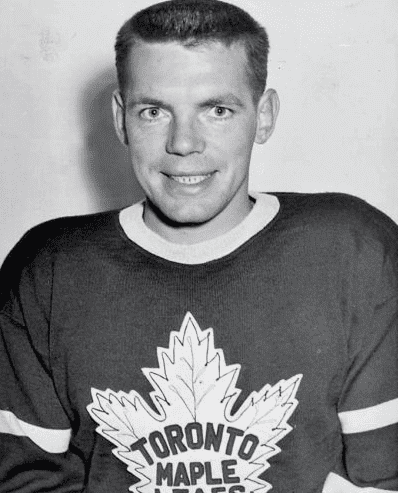
In his first season with the Toronto Maple Leafs, Meeker scored 27 goals and his performance earned him the 1947 Calder Trophy as the NHL's top rookie. Early on in Toronto, he played right wing on the KML line with Leafs' legend Ted Kennedy and Vic Lynn. In addition to his hockey duties, Meeker became a Member of Parliament (1951-1953) in the Canadian government. Meeker captured four Stanley Cups with Toronto.

After his career came to a close as an active player in 1954, he coached the senior Stratford Indians in the OHA for one term. Then, Meeker spent two years mentoring the AHL Pittsburgh Hornets. This was followed by one season, 1956-57, behind the Leafs' bench. His gig as the Maple Leafs' GM in 1957-58 was aborted before the regular season got underway.

Meeker turned to broadcasting and earned a spot in the broadcaster's wing of the Hockey Hall of Fame in 1998 for his work as an analyst on Hockey Night in Canada.

For many, a lasting memory is the Howie Meeker Hockey School series that aired on the CBC. Meeker was at his boisterous best explaining the techniques of how to play the game. His unique delivery and a constant stream of his catch-phrase, "Golly Gee," made him highly popular with a generation of hockey fans.